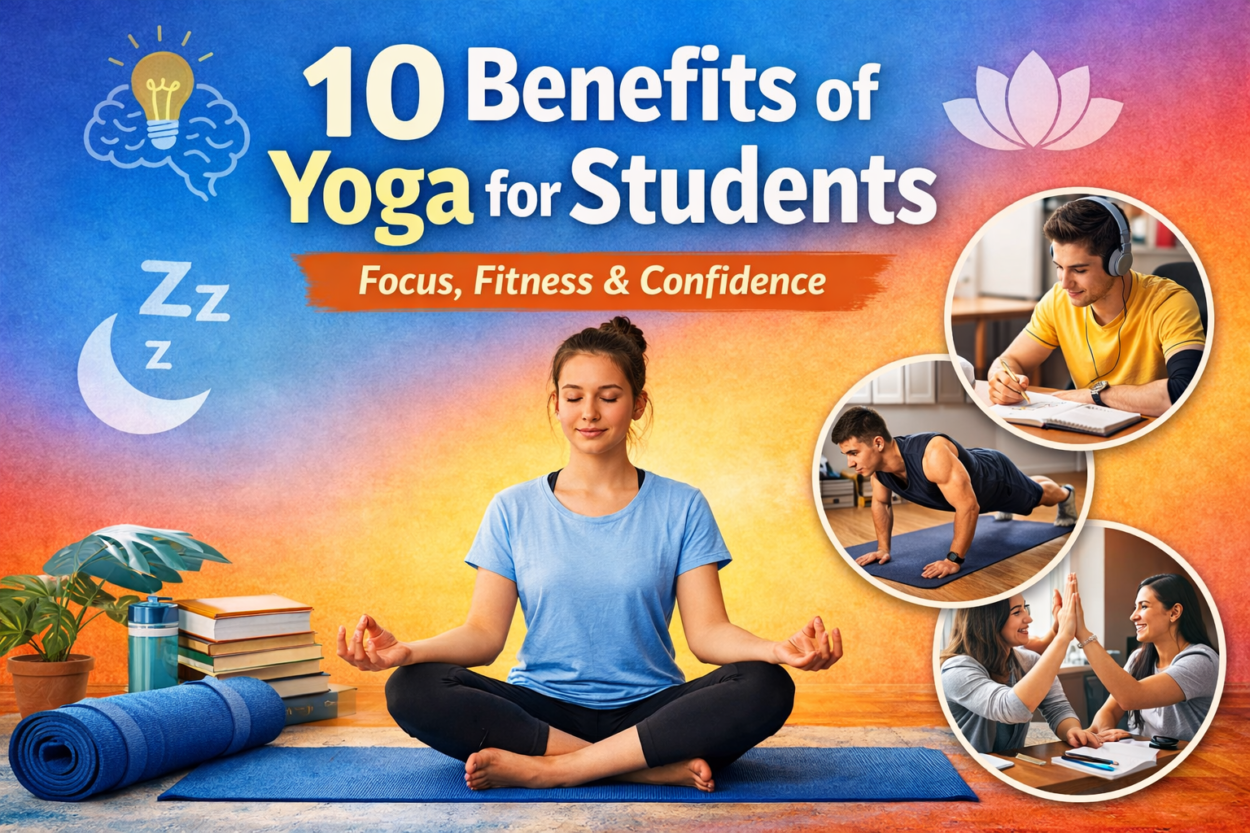
Student life can feel like a lot at once. Classes, exams, assignments, screens, late nights and constant pressure to do well. When your mind feels busy, even simple tasks take longer. When your body feels stiff or tired, your mood drops too.
That is where yoga helps. Yoga is not just stretching. It is a mix of movement, breathing and calm attention. Done regularly and it can make your study hours sharper, your body stronger and your confidence steadier.
This guide covers the benefits of yoga for students in a clear & practical way. You will also get quick routines you can do in a small space, even at a study desk.
Quick start: yoga in 10 minutes (before studying or between classes)
Do this when you feel distracted, sleepy or tense.
Minute 1: Breathing to settle the mind
- Sit tall. Inhale through the nose for 4 counts.
- Exhale through the nose for 6 counts.
- Repeat for 6 breaths.
Minutes 2–4: Loosen the “study posture”
- Shoulder rolls: 10 slow circles back, 10 forward
- Neck stretch: ear to shoulder, 20 seconds each side
- Wrist stretch: 20 seconds each side
Minutes 5–7: Wake up the spine
- Seated cat-cow: round the back, then lift the chest (8 rounds)
- Seated twist: 20 seconds each side
Minutes 8–10: Reset your energy
Pick one:
- Forward fold (standing or seated) for 45 seconds
- Child’s pose for 60 seconds
- Legs up the wall for 2 minutes (best for heavy legs and stress)
You should feel calmer and more “ready” to start.
Desk-friendly moves (no mat needed)
These are great during long study hours.
- Seated side stretch: reach one arm up, lean gently (20 seconds each side)
- Seated twist: look over your shoulder (20 seconds each side)
- Ankle rolls: 10 each side (helps after sitting too long)
- Chest opener: clasp hands behind your back and lift gently (20 seconds)
- Eye break: look far away for 20 seconds, then close eyes for 10 seconds
10 benefits of yoga for students (with simple ways to try each one)
1) Better focus while studying
Yoga trains you to bring attention back when it drifts. Breathing slowly also helps your body shift out of stress mode, so your mind stops racing.
Try this (2 minutes):
- Sit tall, inhale 4 counts, exhale 6 counts
- While breathing, keep your eyes on one point on the wall
- When thoughts come, gently return to the breath
Over the time, this skill shows up during study too: less drifting, more steady work.
2) Lower stress during exams and deadlines
Stress is not only mental. Your shoulders tighten, your jaw locks & your stomach feels off. Yoga relaxes the body and that sends a calming signal back to the brain. The U.S. NIH’s NCCIH lists stress relief and mental well-being as common reasons people use yoga, along with improved sleep.
Try this “exam calm” breathing (90 seconds):
- Inhale through the nose (4 counts)
- Exhale slowly (6–8 counts)
- On every exhale, drop your shoulders
Do it outside the exam hall, or right before opening your laptop for a test.
3) Better sleep and easier winding down at night
A tired brain needs sleep to store memory and recover. Late-night scrolling and stress make sleep harder. Gentle yoga in the evening helps your nervous system slow down.
A recent student-focused study on short Yoga Nidra (a guided relaxation style) looked at sleep quality outcomes in students.
Try this night routine (6–8 minutes):
- Child’s pose: 1 minute
- Seated forward fold: 1 minute
- Legs up the wall: 3–5 minutes
- Slow breathing: inhale 4, exhale 6 for 6 rounds
Keep it soft. Night yoga is not the time for intense moves.
4) More energy during the day (without extra caffeine)
When you sit for hours, your body gets dull and sleepy. A short flow increases blood movement, opens the chest and helps you feel more awake.
Try this “study break boost” (3 minutes):
- Mountain pose: 30 seconds (stand tall, breathe)
- Chair pose: 20 seconds
- Forward fold: 30 seconds
- Half lift (flat back): 15 seconds
- Repeat once
You don’t need a full session. Small resets work.
5) Stronger posture and less back or neck pain from long sitting
Students spend a lot of time bent over books and phones. This pulls the shoulders forward and strains the neck. Yoga strengthens the upper back and opens tight chest muscles.
Try these 2 moves (2–3 minutes):
- Chest opener stretch: 30 seconds
- Cat-cow: 8 slow rounds
- Gentle cobra (on the floor) or standing backbend: 20 seconds
If you do this daily, your sitting posture improves and discomfort reduces.
6) Better flexibility and fewer “stiff body” days
Flexibility is not about doing fancy poses. It is about moving easily without feeling tight all the time. Yoga improves range in hips, hamstrings, shoulders, and ankles, which helps in daily life and sports too.
Try this simple stretch set (4 minutes):
- Low lunge (or a short step lunge): 30 seconds each side
- Seated hamstring stretch: 45 seconds each side
- Shoulder stretch across chest: 30 seconds each side
Go slow. Stretching should feel strong but not sharp.
7) More strength and body control
Yoga builds strength using your own body weight. Poses like plank, downward dog and warrior train arms, core, legs and balance together.
Try this mini strength set (5 minutes):
- Downward dog: 30 seconds
- Plank: 20 seconds
- Child’s pose: 20 seconds
- Warrior II: 30 seconds each side
- Repeat once
This helps students who want fitness but don’t have time for a long gym session.
8) Better breathing and calmer nerves
Many students breathe shallow when stressed. Yoga teaches fuller breathing, which can steady heart rate and calm nerves. This is useful in presentations, viva and interviews too.
Try “humming breath” (1 minute):
- Inhale through the nose
- Exhale with a soft hum (like “mmm”)
- Feel the vibration in the face and chest
- Repeat 5–6 times
It’s quick, quiet, and calming.
9) Better mood and more patience with yourself
When you feel behind, it’s easy to get harsh with yourself. Yoga supports a calmer mood by reducing body tension and teaching you to pause before reacting.
Try this 60-second reset when you feel irritated:
- Sit tall, one hand on chest, one on belly
- Inhale slowly
- Exhale longer than inhale
- Ask: “What is the next small step I can do?”
That small pause can change your whole evening.
10) More confidence and self-discipline
Confidence grows when you keep promises to yourself. Yoga is small, repeatable, and measurable. You show up, you finish, you feel better. That builds trust in yourself.
There’s also research linking yoga programs with student outcomes. One study on a yoga module reported better academic performance compared to a control group.
Simple way to build this habit:
- Pick a time you already have: after brushing teeth, after classes, before dinner
- Start with 10 minutes, three days a week
- Track one thing after each session: mood, energy, or sleep quality
Confidence becomes real when you see progress.
A safe weekly plan for busy students (no long sessions)
Mon / Wed / Fri (15 minutes):
- 10-minute routine + 5 minutes of strength (plank, warrior, chair)
Tue / Thu (10 minutes):
- Desk-friendly moves + breathing
Sat (20 minutes):
- A relaxed full-body session or a campus class
Sun (5–10 minutes):
- Legs up the wall + slow breathing
Small and steady beats “once in a while and intense.”
Safety tips (so beginners don’t get hurt)
- Move slowly in the start. Speed causes strain.
- Pain is a stop signal. Stretch feeling is fine, sharp pain is not.
- If you have an injury, choose gentle moves and get medical advice if needed.
- Use support: a chair, wall, folded towel, or cushion.
- If balance is hard, do standing poses near a wall.
Yoga should feel like support, not punishment.
Good options for students who feel shy or new
- Start in your room with a short routine.
- Join a college club with a friend.
- Try a beginner class where teachers offer easier versions.
- If sitting on the floor is hard, do seated yoga on a chair.
Yoga works for many body types and ability levels. You just need a version that suits you.
Final thought
The benefits of yoga for students go way past flexibility. Yoga helps you study with a steadier mind, carry your day with less stress and feel more confident in your own skin. Start small. Ten minutes is enough to begin.


Leave a Comment